In an era where automation and AI are reshaping business operations, selecting the best AI workflow builder is a strategic decision that can determine your team’s efficiency, scalability, and innovation pace. This guide will walk you through everything from core definitions to comparisons, use cases, and advice on implementation- with a special look at AI agent workflow builders and the growing importance of Slack AI workflow builder integrations.
What Is an AI Workflow Builder?
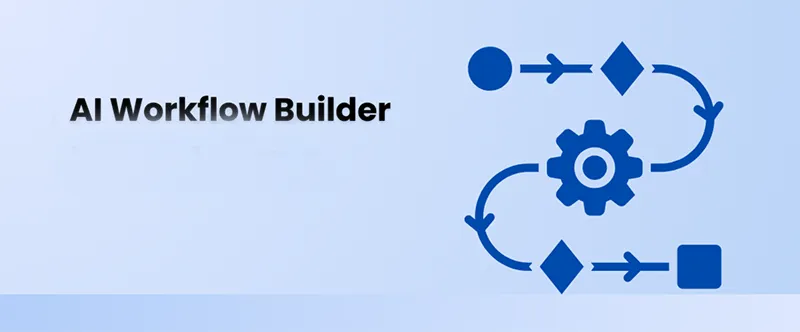
At its core, an AI workflow builder is a platform or tool that allows you to design, orchestrate, and execute process flows enhanced by AI capabilities. Unlike traditional automation tools that rely on fixed rules or simple triggers, modern AI workflow builders incorporate techniques such as:
- Natural Language Processing (NLP)
- Machine Learning (classification, prediction)
- Generative AI (text, summarization, content creation)
- Agent orchestration (autonomous decision-making)
In other words, instead of a rigid “if-then” chain, you can build workflows that adapt dynamically: branching logic based on data, context-aware triggers, or even events driven by AI agents themselves.

These builders often support a drag-and-drop canvas or visual interface, making them accessible even to non-technical users. You connect “nodes” or “steps” that represent triggers, actions, conditional logic, or AI-powered tasks (e.g. summarizing text, classifying sentiment, creating content). The platform handles the orchestration, integration, and execution.
You may be interested AI powered workflow: Automation, Innovation, and Clinical Applications
Why the Rise of AI Agent Workflow Builders Matters?
While AI workflow builders manage and automate tasks, the evolution toward AI agent workflow builder platforms is a significant leap forward. An AI agent workflow builder is designed not just to run workflows, but to create and manage intelligent agents -autonomous software entities that can reason, act, and interact with humans or other agents.
Here are key differentiators:
| Capability | Traditional AI Workflow | AI Agent Workflow Builder |
|---|---|---|
| Triggered tasks | Static or rule-based triggers | Agent-initiated workflows based on context |
| Adaptability | Limited branching logic | Agents can learn, self-correct, coordinate |
| Autonomy | Human supervision required | Agents can act independently within limits |
| Collaboration | Linear flows | Multi-agent orchestration for complex goals |
For example, a sales AI agent might monitor inbound leads, assess intent, and then initiate personalized outreach across email, Slack, or CRM systems – all without human intervention. Simultaneously, a support AI agent can handle Tier 1 queries, escalate complex ones, and update the internal ticketing system.
Thus, the best AI workflow builder in 2025 increasingly refers to platforms that support agent-level capabilities – not just simple automations.
You may be interested AI workflow management
What Makes a Great AI Workflow Builder? (Criteria & Metrics)
Before comparing platforms, it’s helpful to define what “great” means in this context. The Cybernews article highlights several key attributes, and we should adopt and expand on those to match your SEO goals.
Here are essential evaluation criteria:
- AI Automation & Advanced Capabilities. The ability to automate both standard and complex tasks, including classification, language understanding, and content generation.
- Ease of Use / UX. Even non-technical users should be able to build, edit, and manage workflows with minimal friction.
- Integrations & Extensibility. The system should connect seamlessly with your existing stack – Slack, CRM, email, cloud storage, databases, internal APIs.
- Customization / Flexibility. The ability to define custom triggers, branching logic, conditional steps, agent policies, and fallback paths.
- Analytics & Monitoring. Metrics, logs, dashboards, and feedback loops to measure performance, error rates, bottlenecks – and optimize.
- Scalability & Reliability. Can it handle growth in usage, complexity, and data volume without failure or performance degradation?

- Pricing & ROI. Cost matters: affordability, transparent plans, scalability, and whether the tool justifies the ROI.
- Support & Ecosystem. Documentation, community, templates, training, customer support, and templates or marketplace of workflows.
By judging candidate platforms against these dimensions, you can more confidently evaluate which is the best AI workflow builder for your use case.
You may be interested AI Workflow Automation: Transforming Business Processes
Top AI Workflow Builders in 2025 (with Agent Potential)
LikeFlow: A Strong Contender Among Top AI Workflow Builders in 2025
When considering the best AI workflow builders, LikeFlow stands out as a platform with significant agentic potential. It bridges the gap between simple automation and intelligent, multi-agent systems. Below are its key strengths, possible limitations, and how it compares to other players in the field.
Key Strengths of LikeFlow:
- Advanced agentic capabilities: Beyond linear automation, LikeFlow supports multi-agent orchestration to achieve complex goals.
- User-friendly interface: A visual drag-and-drop builder makes it easy for even non-technical users to create workflows.
- Extensive integrations: Works seamlessly with Slack, CRM, email, internal APIs, and other enterprise tools.
- Flexibility & customization: Users can define custom triggers, branching logic, and agent policies.
- Analytics & optimization: Dashboards, logs, and feedback loops help track performance and continuously improve workflows.

Potential Limitations
- The number of pre-built templates may not be as rich as some long-standing competitors.
- Because of its strong agentic features, beginners might need some time to get familiar with the platform.
n8n (Open-source, extensible)
Cybernews calls n8n “the best AI workflow builder in 2025” for many uses. It offers:
- A visual drag-and-drop interface.
- Integration with over 400 apps.
- Self-hosting and cloud-hosting flexibility.
- Ability to “trigger Slack message when file is uploaded in Google Drive” workflows and more.

While n8n is not agent-native out of the box, its extensible architecture allows advanced users to integrate AI modules, custom code, or agent orchestration layers.
Pros: open-source, powerful, flexible
Cons: fewer pre-built AI/agent templates, steeper for novices
Zapier + AI/LLM integrations
Zapier has been a stalwart of process automation, and now with AI/LLM plugin support it remains relevant. Cybernews highlights:
- Over 7,000 app integrations.
- Integrated AI apps (ChatGPT, Claude, etc.).
- Ability to start workflows via chat prompts or Copilot.
- AI features such as summarization, prompt templates, branching logic.
Zapier is great as a bridge or glue layer but is limited when it comes to true agent autonomy.
You may be interested The Future of AI Agentic Workflows
ClickUp (AI-enhanced project & workflow suite)
ClickUp is a fully featured project management and workflow suite with AI enhancements. Cybernews notes:
- 1,000+ integrations.
- Built-in AI features (summarization, content generation).
- Workflow automation tied to tasks, statuses, files.
While not a pure AI agent platform, ClickUp’s integration makes it valuable in many stacks.
Gumloop
Gumloop is another no-code workflow builder with AI modules. It offers:
- A visual flow canvas.
- Chrome extension for browser action recording / scraping.
- Templates such as “generate blog posts from YouTube videos,” resume screening, SEO keyword research.
It’s more niche and premium-priced.

Flowise
Flowise is more LLM / chatbot–oriented, but often overlaps with workflow platforms since chat agents need orchestration. Cybernews describes it as:
- Open-source, drag-and-drop for building chatbot workflows
- LLM component library
- Suitable for e-commerce workflows, support bots, agent-like chat flows

Slack AI Workflow Builder: Why It’s a Game Changer
Since Slack is already central to many team workflows, a Slack AI workflow builder enables you to embed agents directly into communications:
- Trigger workflows from Slack commands or message detection
- Let agents respond conversationally
- Surface decisions, summaries, or tasks from Slack
- Use Slack as both UI and control panel
When your AI workflow builder offers native Slack integration, you get deeper synergy: conversational triggers, thread-level context, messaging-based handoffs. A Slack-integrated agent can understand message threads, fetch relevant context, escalate, or respond – all within Slack.
Platforms like Likeflow, n8n or Zapier can already connect triggers and actions to Slack; advanced platforms push that further, making Slack a conversational interface for your agent network.
You may be interested Ai search engine: Transforming How We Find Information
[FAQ] About AI Workflow Builders
- How does an AI workflow builder work?
AI workflow builders work by connecting triggers, actions, and AI models into a step-by-step process. For example, when a new customer signs up, the workflow might automatically send a welcome email, analyze customer behavior, and assign a personalized AI agent to follow up. Advanced builders, like LikeFlow, can even give workflows “memory,” so agents remember past interactions and adapt responses over time.
- What is the difference between an AI workflow builder and traditional automation tools?
Traditional workflow tools (like Zapier or IFTTT) mostly rely on static “if-this-then-that” logic. AI workflow builders go further by integrating AI models that can interpret text, analyze unstructured data, and generate human-like outputs. This enables workflows to be more dynamic, context-aware, and personalized.
- What is an AI agent workflow builder?
An AI agent workflow builder is a specialized platform that not only automates processes but also creates autonomous AI agents. These agents can interact with customers, analyze documents, make recommendations, or trigger actions across systems- all while adapting to context. Tools like LikeFlow are leading this new wave of agent-powered workflows.
- Which is the best AI workflow builder in 2025?
The “best” AI workflow builder depends on your needs. For enterprises, platforms like n8n or Zapier with AI integrations offer scale and deep integrations. For teams and SMEs, LikeFlow is one of the top choices in 2025 because it combines multi-model support, memory-enabled AI agents, and easy no-code setup.
- Can AI workflow builders integrate with Slack?
Yes, many AI workflow builders provide Slack AI workflow integrations. This allows teams to trigger AI agents directly inside Slack—for example, summarizing messages, automating reports, or generating AI responses in real-time. LikeFlow and other platforms also integrate with communication tools to streamline collaboration.
- Do AI workflow builders require coding skills?
Not always. Most modern AI workflow builders, including LikeFlow, are designed as no-code or low-code platforms. This makes them accessible to non-technical users while still offering advanced customization for developers who want more control.

- Are AI workflow builders expensive?
The cost varies depending on the platform and usage. Many providers offer free tiers or entry-level plans. Advanced features-like multi-agent orchestration, large API call volumes, or enterprise security-usually come with higher-tier pricing. Businesses should evaluate both functionality and scalability before committing.
- What is the future of AI workflow builders?
AI workflow builders are moving toward agentic workflows- where multiple AI agents collaborate autonomously across tasks. In the near future, businesses may rely on AI agents to manage entire customer lifecycles, internal operations, and decision-making processes with minimal human oversight.
You may be interested Customer support tools for your business
The rise of AI workflow builder platforms is rewriting how work gets done. When those platforms begin supporting AI agent workflow builders, you unlock autonomous systems that think, act, and scale. Integrating those workflows into Slack via a Slack AI workflow builder makes automation innate to your team’s daily interactions.
A user-friendly AI platform that’s easy to deploy, helping SMEs automate processes, boost efficiency, and connect with customers naturally.
LIKEFLOW – Smarter AI, Faster Growth
- Phone : +1(719) 313 7576
- Email : support@likeflow.ai
- Address : 1942 Broadway St. STE 314C Boulder CO 80302



Leave a Reply