Search has always been the backbone of the internet. From the early days of simple keyword lookups to today’s complex semantic understanding, the way we find information online has constantly evolved. But in recent years, a new force has entered the scene – AI search engines. Powered by machine learning, natural language processing (NLP), and generative AI, these next-generation platforms are reshaping how users search, how businesses optimize content, and how digital marketing strategies are built.

By the end, you’ll have a clear understanding of why AI search is not just a trend but the future of information retrieval.
What is an AI Search Engine?
An AI search engine goes beyond matching keywords with indexed pages. Instead, it understands queries in a more human-like way – considering context, intent, and even conversational tone. These search engines use advanced algorithms such as:
- Natural Language Processing (NLP): Helps interpret queries written in everyday language, even if they are vague or conversational.
- Machine Learning Models: Continuously improve results by learning from user interactions.
- Generative AI: Some AI search engines don’t just point to sources – they generate summaries, insights, and direct answers.
For example, when you ask a traditional engine like Google:
“What are the health benefits of green tea?”
You’ll get a list of links with snippets.
You may be interested The Future of AI Agentic Workflows

But with an AI search engine, you might see:
- A summarized answer explaining antioxidants, metabolism, and relaxation benefits.
- A breakdown of references.
- Related questions like “How much green tea should I drink daily?”
This makes the search experience more interactive, personalized, and efficient.
Why AI Search Engines Are Different
Traditional search engines rely heavily on indexing web pages and ranking them by relevance and authority. AI search engines, however, focus on understanding meaning rather than just matching words. Here are a few key differences:
- Conversational Queries. Users can type or speak questions as naturally as they would ask a friend.
- Contextual Awareness. AI engines can remember the context of previous queries. For instance, if you first ask “Who is the CEO of Tesla?” and then follow up with “How old is he?” the AI understands you’re still talking about Elon Musk.
- Multimodal Search. Some AI search engines allow image or voice-based search, combining text, pictures, and videos.
- Direct Answers Instead of Links. Instead of browsing multiple pages, users often get a comprehensive, AI-generated answer instantly.
You may be interested AI Chat Pro: The Smart AI Assistant

AI Search Engine Optimization Tools
With AI powering search, businesses need new strategies to stay visible. This is where AI search engine optimization tools come in. These tools leverage AI themselves to help marketers understand ranking factors, user intent, and content optimization in the new era of search.
Here’s how they help:
- Content Optimization: AI SEO tools analyze search intent and recommend keywords, headings, and even tone adjustments.
- Predictive Analytics: Forecast which topics will trend and how users may phrase future queries.
- Voice Search Optimization: Helps adapt content for voice-based queries, which are increasingly popular with AI assistants.
- Competitor Insights: Analyze how competitors perform in AI-driven search rankings.
- Semantic Search Enhancement: Focus not just on keywords but on entities and topics.

Popular AI SEO optimization tools include:
- Surfer SEO – for semantic keyword optimization.
- Frase.io – for AI-powered content briefs and summaries.
- SEMRush AI Tools – integrating NLP to refine keyword targeting.
- ChatGPT Plugins for SEO – assisting in generating optimized, natural content.
In short, just as AI is changing search, it’s also reshaping the very tools marketers use to prepare content for it.
You may be interested AI Workflow Automation: Transforming Business Processes
AI Search Engines You Can Try for Free
One of the best things about this technological shift is accessibility. There are now several AI search engines free to use. Some offer premium upgrades, but the basic versions still provide impressive capabilities:
- Likeflow AI is a powerful AI search engine free for everyone, designed to deliver fast and precise answers. It combines natural language processing with real-time data to understand queries just like a human assistant. Users can explore web content, summaries, and insights without endless scrolling through links. Smart, simple, and accessible – LikeFlow AI makes searching the internet smoother and more intuitive.

- Perplexity AI – Delivers conversational answers with source citations.
- You.com – Combines web results with AI summaries and app-like integrations.
- NeevaAI (before merging with Snowflake) – Focused on ad-free, user-centric AI results.
- Bing AI (Microsoft Copilot) – Integrates OpenAI’s GPT models directly into search.
- ChatGPT with Browsing (OpenAI) – While technically a chatbot, it functions as an AI search engine free with real-time web access.
These platforms show how quickly AI search is becoming mainstream and accessible to everyone, not just tech professionals.
You may be interested AI Voice Generators: Free Tools & the Best Options Over the Years

The Best AI Search Engines in 2025
Choosing the best AI search engine depends on what you’re looking for: accuracy, speed, personalization, or integration with daily tools. Here are some of the top contenders for 2025:
- LikeFlow AI stands out among the best AI search engines in 2025, offering accurate, conversational answers with an intuitive interface. It blends speed, context understanding, and real-time web insights to deliver more than just links—providing clear, actionable knowledge. Trusted by professionals and everyday users alike, LikeFlow is shaping the future of smart, AI-powered search.

- Google Search with Gemini AI. Google remains dominant, but with Gemini (its advanced AI model), it is transforming search into a more interactive, answer-focused experience.
- Microsoft Bing AI. With OpenAI’s GPT-4 integration, Bing has made a massive comeback. It excels in summarizing results and offering conversational follow-ups.
- Perplexity AI. Known for its clean, citation-heavy answers, Perplexity is becoming the go-to for students, researchers, and professionals who need reliable references.
- You.com. Popular among younger audiences, You.com is customizable and blends web results with productivity tools.
- ChatGPT with Browsing. While not branded as a “search engine,” its ability to analyze queries, browse in real-time, and generate natural answers makes it a powerful search alternative.

Each of these has unique strengths, making it hard to crown just one as the best AI search engine. Instead, the right choice depends on your goals – whether research, shopping, productivity, or general browsing.
You may be interested How to make ai chatbot: A Complete Guide
How AI Search is Changing SEO and Digital Marketing
The rise of AI-driven search means businesses must rethink how they appear online. Some major shifts include:
- Content Quality Over Quantity: AI filters out low-quality, keyword-stuffed articles, rewarding clear, authoritative content.
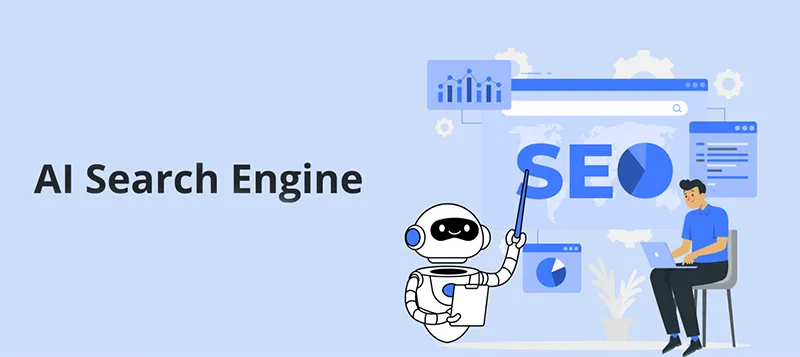
- Entity-Based Optimization: SEO is moving from keywords to topics and entities (e.g., optimizing for “electric cars” instead of just “Tesla”).
- Conversational Content: Since AI search engines handle natural language, writing content in a conversational style improves visibility.
- Structured Data: Schema markup and structured data help AI understand context better.
- Personalization: AI search adapts to individual user profiles, meaning businesses must diversify content to cater to different audiences.
For marketers, adopting AI search engine optimization tools and updating strategies early will ensure they stay ahead.
You may be interested List of free llm models to use unlimited
(FAQ) – ai search engine
Q1. How is an AI search engine different from Google?
Google is adding AI features, but traditional search engines still rely on keyword indexing. AI search engines focus on understanding intent, generating direct answers, and supporting conversational follow-ups.

Q2. Are there AI search engines free to use?
Yes. Popular AI search engine free options include Perplexity AI, You.com, Bing AI, and LikeFlow AI. They provide instant answers, summaries, and references without requiring a paid subscription.
Q3. What are the best AI search engines in 2025?
The best AI search engines in 2025 include Google Gemini, Microsoft Bing AI, Perplexity AI, You.com, ChatGPT with browsing, and LikeFlow AI – each excelling in speed, personalization, or accuracy.
Q4. How can businesses optimize for AI search engines?
Companies should focus on high-quality, conversational content, use structured data, and adopt AI search engine optimization tools to improve visibility in AI-driven results.
Q5. Can AI search engines replace traditional search engines?
Not entirely at least not yet. AI search engines are excellent for direct answers and summaries, while traditional search engines still excel at providing comprehensive lists of resources.
You may be interested AI Image Search: The Future of Visual Discovery
The evolution from traditional search engines to AI search engines marks one of the biggest technological shifts in digital history. From AI search engine optimization tools that redefine marketing strategies, to AI search engines free for casual users, and the ongoing competition for the best AI search engine, the landscape is rapidly changing.
A user-friendly AI platform that’s easy to deploy, helping SMEs automate processes, boost efficiency, and connect with customers naturally.
LIKEFLOW – Smarter AI, Faster Growth
- Phone : +1(719) 313 7576
- Email : support@likeflow.ai
- Address : 1942 Broadway St. STE 314C Boulder CO 80302




Leave a Reply