Digital marketing has always been about adapting to change—search engines, social media, mobile-first experiences, and now artificial intelligence. The rise of AI digital marketing is not just another trend; it is a complete shift in how businesses reach, understand, and engage with their audiences. From predictive analytics to personalized campaigns, AI is enabling brands to create smarter strategies, automate repetitive tasks, and scale customer experiences like never before.
As organizations search for ways to stay competitive, the role of an AI marketing agency becomes increasingly important. These agencies combine traditional marketing expertise with advanced machine learning tools to optimize campaigns and deliver measurable results.
In this article, we will explore what AI digital marketing really means, its benefits, real-world use cases, tools shaping the landscape, and how businesses can choose the right AI marketing agency.
What is AI Digital Marketing?
AI digital marketing refers to the integration of artificial intelligence technologies—such as machine learning, natural language processing (NLP), and predictive analytics—into marketing strategies and campaigns. Unlike traditional digital marketing, which relies heavily on human decision-making, AI marketing uses algorithms and data analysis to make informed, real-time choices.
For example, instead of manually segmenting email lists, AI can analyze thousands of data points (demographics, behavior, past interactions) to deliver highly personalized recommendations. Instead of guessing which ad will perform best, AI can run A/B tests autonomously and scale the winning version instantly.
Why AI in Digital Marketing is the Future
AI is no longer optional in the digital landscape. Here are the key reasons businesses are investing in AI in digital marketing:
- Data-Driven Insights. With billions of customer interactions happening online every day, it’s impossible for marketers to process everything manually. AI can analyze massive amounts of structured and unstructured data, uncover hidden patterns, and provide actionable insights.
- Hyper-Personalization. Consumers expect more than generic ads. AI allows businesses to deliver personalized messages, product recommendations, and content that resonate with individual users.
- Automation at Scale. From email campaigns to social media posting, AI automates repetitive tasks, freeing marketers to focus on strategy and creativity.
- Predictive Power. AI can forecast future customer behaviors, such as purchase intent or churn risk, enabling proactive engagement.
- Improved ROI. By optimizing ad spend, targeting the right audience, and increasing conversions, AI digital marketing improves overall marketing return on investment.
You may be interested Best AI Marketing Tools & How to Use AI in Marketing
How to Use AI in Digital Marketing
As AI tools become more accessible and user-friendly, businesses are increasingly adopting them in everyday marketing tasks—from generating ad copy for PPC campaigns to setting up automated email workflows.
According to the Digital Marketing Institute, 60% of marketers say they are familiar with AI and its applications, yet 37% still don’t have an AI strategy in place. This raises an important question: how exactly are marketers using AI, and what impact is it having?
Content and Image Creation
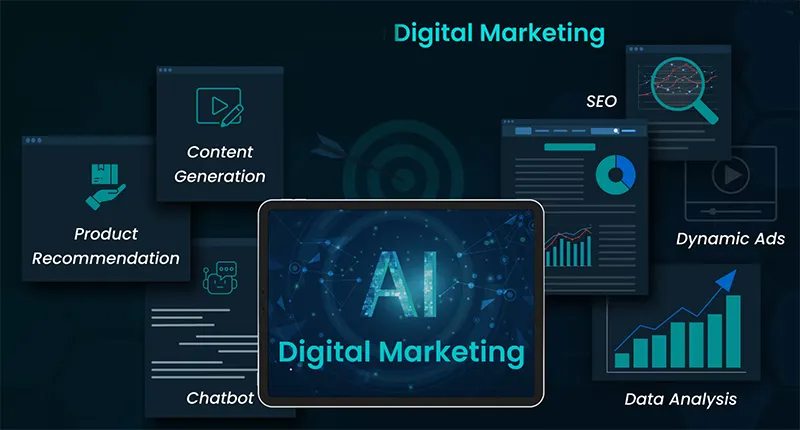
Marketing teams often struggle with the demand to produce large volumes of high-quality content quickly. Generative AI tools such as ChatGPT and Claude have surged in popularity because they help create copy for emails, ads, landing pages, blogs, and more. Marketers also use AI prompts to craft engaging headlines, tailor messages to different audience segments, and even support influencer marketing campaigns.
While these tools save time and money, experts caution that all AI-generated content should be reviewed to ensure it reflects the brand voice. As Mischa McInerney, CMO at the Digital Marketing Institute, notes: “People use AI because it’s lower cost and highly scalable. But without a creative strategy and data-driven insights, it’s just spray and pray.”
Customer Service and Support
AI chatbots have become a standard way for customers to get instant answers. But AI goes further—it can personalize messaging, predict customer needs, streamline purchasing, and route queries to the right team. According to Mailchimp, 88% of marketers say they must increase AI and automation use to meet customer expectations and remain competitive.
Customer Segmentation
Segmentation is critical for targeting high-value customers, but it can be slow and costly to do manually. AI algorithms can group audiences by shared behaviors, interests, or needs and then adjust targeting in real time. Recommendation engines and Natural Language Processing (NLP) tools further personalize offers and extract insights from reviews or feedback, improving customer experience.
SEO
AI is transforming SEO, building on Google’s advanced ranking algorithms and extending into new areas such as AI Overviews (formerly Search Generative Experience). Marketers can leverage AI to automate keyword research, optimize content, create meta tags, and even forecast trends with predictive SEO. With voice and visual search on the rise, NLP and metadata optimization are becoming essential for visibility.

Pay-Per-Click Advertising (PPC)
PPC remains a cornerstone of digital advertising, and AI is raising its effectiveness. It can refine keyword targeting, optimize bidding, enhance ad creative, and detect fraud. As AI evolves, marketers can expect new ad formats, smarter targeting, and more advanced analytics—making it vital to stay current with developments.
Data Analytics
With massive volumes of data across multiple channels, marketers risk drowning in information. AI helps process and analyze data at scale, identify anomalies, uncover patterns, and even predict customer behaviors. This enables hyper-personalization and smarter business decisions, such as inventory optimization in retail. Tools like ChatGPT’s Advanced Data Analysis feature allow marketers to upload spreadsheets and extract deep, actionable insights.
Email Marketing
Email remains a powerful channel for conversions and customer engagement. AI tools enhance email marketing by analyzing campaign performance, generating subject lines, personalizing content, creating triggered workflows, and optimizing send times. They also support A/B testing and email list curation.
A Selzy report shows 63% of users trust AI email tools but still double-check outputs, while 25% fully rely on them. This highlights the balance between automation and human oversight in maintaining quality.
You may be interested The Rise of AI Marketing Agents
The Pros and Cons of AI in Digital Marketing
Like any transformative technology, artificial intelligence brings both opportunities and challenges to digital marketing. While it can significantly enhance efficiency and personalization, it also raises ethical and practical concerns around data use, transparency, and bias.
As Jim Leckinski, Associate Professor at the Kellogg School of Marketing, Northwestern University, puts it: “AI is no longer a niche topic for a few tuned-in geeks. It’s an area that all marketers need to become knowledgeable about—quickly.”
Pros of AI in Digital Marketing
- Boosts productivity – AI automates repetitive tasks, freeing up marketers to focus on strategy, creativity, and complex problem-solving.
- Drives efficiency – Mundane activities like data entry, lead sorting, or customer query responses can be handled seamlessly.
- Reveals deeper insights – By eliminating guesswork, AI provides data-driven intelligence that enables smarter decision-making and uncovers new marketing opportunities.
- Increases ROI – Through predictive analytics, AI evaluates customer behavior, improves user experiences, and delivers relevant content that supports conversions.
- Creates and optimizes content – AI tools generate quality copy and visuals at scale, making it easier to keep multiple channels active and consistent.
- Personalizes at scale – By analyzing customer data, AI delivers tailored recommendations, offers, and messaging that strengthen engagement.
- Predictive analysis – AI can forecast customer behavior and market trends using historical data, giving marketers a head start in planning.
- Task automation – From customer segmentation to email sorting and reporting, AI handles routine tasks quickly and accurately.
Cons of AI in Digital Marketing
- Bias in data – Since AI systems learn from historical datasets, they may reflect or even amplify racial, gender, cultural, or socioeconomic biases.
- Inaccuracy risks – Faulty or incomplete data can lead to flawed insights, misdirected campaigns, and costly mistakes.
- Ethical concerns – Hyper-targeted advertising and behavioral manipulation raise questions about user consent and the “creepiness factor.”
- Data sensitivity and security – AI often relies on large datasets, including sensitive customer information, which must be carefully protected.
- Transparency challenges – As AI-generated content becomes more widespread, issues around authorship, plagiarism, and intellectual property ownership become increasingly complex.
Benefits of AI Digital Marketing & Real-World Examples
Benefits of AI Digital Marketing
- Enhanced Customer Experience. Personalized recommendations, faster responses, and relevant content build stronger customer relationships.
- Efficiency and Cost Savings. AI automates repetitive tasks, reducing human error and operational costs.
- Better Decision-Making. Marketers can rely on AI-driven insights instead of intuition, leading to smarter strategies.
- Competitive Advantage. Companies adopting AI early can stay ahead of competitors by offering innovative experiences.

Real-World Examples of AI in Digital Marketing
- Amazon uses AI to deliver personalized product recommendations that drive a significant portion of its sales.
- Netflix applies machine learning to suggest movies and shows tailored to individual preferences.
- Spotify creates AI-curated playlists that keep users engaged.
- Nike leverages AI chatbots to engage customers in personalized shopping experiences.
These examples demonstrate that AI in digital marketing isn’t theoretical—it’s already reshaping industries.
You may be interested AI marketing automation
Frequently Asked Questions (FAQs) About AI Digital Marketing
- How is AI used in digital marketing?
AI is used in digital marketing through applications like predictive analytics, chatbots, programmatic advertising, content optimization, and personalized recommendations. For example, e-commerce stores use AI to suggest products, while advertisers rely on AI for real-time ad targeting.
- Is AI replacing human marketers?
No. While AI automates repetitive tasks and provides insights, human creativity, empathy, and strategy remain essential. AI should be seen as a tool that enhances human capabilities rather than replacing them.
- What is an AI marketing agency?
An AI marketing agency is a specialized firm that integrates artificial intelligence into digital marketing strategies. These agencies use AI tools to improve SEO, manage automated ad campaigns, optimize content, and deliver personalized customer experiences.
- Is AI digital marketing suitable for small businesses?
Yes. While large enterprises have been early adopters, many affordable AI tools now cater to small and medium businesses. AI can help small businesses automate tasks, optimize ad spend, and compete with bigger brands.
- What challenges come with AI in digital marketing?
Common challenges include data privacy concerns, high initial investment, lack of skilled professionals, and the risk of over-automation. Businesses need to balance AI efficiency with human creativity.
- What is the future of AI in digital marketing?
The future includes more personalized customer journeys, voice search optimization, emotion-detection AI, and seamless hyper-automation across all digital channels. Businesses adopting AI today will have a significant competitive advantage tomorrow.
You may be interested Customer support tools for your business
The integration of AI in digital marketing is reshaping how brands engage with their audiences. From predictive analytics and chatbots to automated advertising and hyper-personalized content, AI empowers businesses to achieve higher efficiency, better ROI, and stronger customer relationships.
For companies looking to leverage these advantages, partnering with an AI marketing agency provides the expertise and technology needed to maximize results.
In the coming years, AI digital marketing will no longer be a differentiator—it will be the standard. Businesses that embrace this transformation today will lead tomorrow’s marketplace.
A user-friendly AI platform that’s easy to deploy, helping SMEs automate processes, boost efficiency, and connect with customers naturally.
LIKEFLOW – Smarter AI, Faster Growth
- Phone : +1(719) 313 7576
- Email : support@likeflow.ai
- Address : 1942 Broadway St. STE 314C Boulder CO 80302

Leave a Reply